Why diaries die, and what that implies about design
The pattern is remarkably consistent. A new diary starts elaborate — timestamps, food, mood paragraphs, trigger theories. It runs for ten to fourteen days. Then a bad week arrives, two days get missed, the record feels broken, and it stops.
What reaches the appointment is a fortnight of rich detail from four months ago, which cannot show a trend. Meanwhile the actually useful record — sparse, consistent, boring, six months long — was never attempted because it looked insufficiently serious.
So the design constraint is not completeness. It is the worst day you will have. If the entry cannot be completed on a day when you slept three hours and everything hurts, the diary will have holes exactly where the interesting data was. Every decision below follows from that.
The columns, and why each one is there
The core five
| Column | What goes in it | Why |
|---|---|---|
| Date | The date. Every day, including zero days. | A recorded zero and a blank mean different things. Blanks destroy trends; zeros make them. |
| Hot flashes | A count, or a fixed band (0 / 1–3 / 4–6 / 7–10 / 10+). | The unit the whole evidence base uses. Bands are fine — bands that change definition are not. |
| Night sweats | A separate count. | Same symptom, different consequence. A combined total hides which one is wrecking your life. |
| Mood | One number on a fixed short scale, 1–5. | Short scales stay consistent over months. The difference between a 6 and a 7 does not survive to next season. |
| Dose taken? | Yes / no / late. One letter is enough. | The single most useful column. Without it, "not working" and "not happening" look identical. |
The four columns most templates leave out
Cycle day
If you are still bleeding at all, number the days from the start of the last bleed. It costs nothing and it is the only way to see whether symptoms cluster in a phase. On a sequential hormone regimen it also lets you see whether anything tracks the progestogen phase — a common question with no answer at all unless the dates exist.
Why you slept badly
Not how long you slept — nobody knows that. How many times you woke, and whether you woke drenched or for no apparent reason. This is the highest-value field in the whole diary, and almost every template omits it. Two wakings with sweats and two without describe different problems.
New symptom
Usually blank, which is the point — a blank column is free. When something new starts, its start date is the fact that matters, and start dates are the thing memory loses first. One line: what, and when it began.
One-word note
A single word for anything unusual: flu, wine, travel, deadline, heatwave. Not a journal. Just enough that a bad week can be recognised later as a bad week rather than misread as a trend.
The paper layout
One landscape page per month. Days down the left, columns across the top, abbreviated headers so they fit: D · CD · HF · NS · Wk · Sw? · Md · Fg · Dose · New · Note. Rule it once, use it for a month, start a fresh page.
Practical details that make paper work:
- Write the scale definitions at the top of every page. Not once at the front — every page. You will otherwise redefine "3" without noticing, and that drift is invisible and unfixable afterwards.
- Pre-print the dates. Empty pre-dated rows create a visible gap when you miss one, which is a far better prompt than a blank page.
- Keep it where the trigger is — beside the bed, next to the kettle, wherever the cue lives. A diary in a drawer is a diary that stops.
- One page per month, kept. Twelve pages is a year of evidence and fits in an envelope.
Digital equivalents work identically, and a spreadsheet with these eleven columns is a perfectly good implementation. The advantage of a spreadsheet or an app is only that it does the arithmetic — see how to track hot flashes for the four numbers you will want computed.
Optional columns, by situation
Add at most two of these, and only if they are relevant to you. The temptation is to add all of them, which is how diaries get abandoned.
- Vaginal and urinary symptoms — dryness, discomfort during sex, urinary urgency. Worth a column if these are among your main problems, because they follow their own timeline and tend to be progressive rather than self-limiting.
- Bleeding — flow, and whether there were clots. Essential if you have a uterus and are on a hormone regimen, because the timing of bleeding relative to the progestogen phase is what separates expected from unexpected.
- Joint aches or breast tenderness — frequently reported, frequently attributed to something else, and both commonly settle or change after a regimen change.
- Injection or patch site — only if you are on those routes, where the site itself is a variable. See estradiol delivery routes.
- Anything specific to you — the symptom no template lists. Electric-shock sensations, skin crawling, ear fullness, palpitations. If it is your main complaint, it belongs in a column no matter how unusual it looks.
How to read your own diary
After a month, three passes take about ten minutes and produce everything you need for an appointment.
- Averages. Mean hot flashes and night sweats per day for the last two weeks. Two numbers.
- Direction. The same two numbers for the fortnight a month or three months earlier. Better, worse, or the same.
- Alignment. Read the mood column against the previous night's wakings, and against cycle day. Does anything line up? An apparent alignment is a question for a clinician, not a conclusion.
Then write those findings on a single sheet and take that in, with the diary as backup. Ninety raw rows will not be read inside a ten-minute consultation; four numbers and a date will. The appointment checklist covers the rest of what to bring.
The same template, as an app
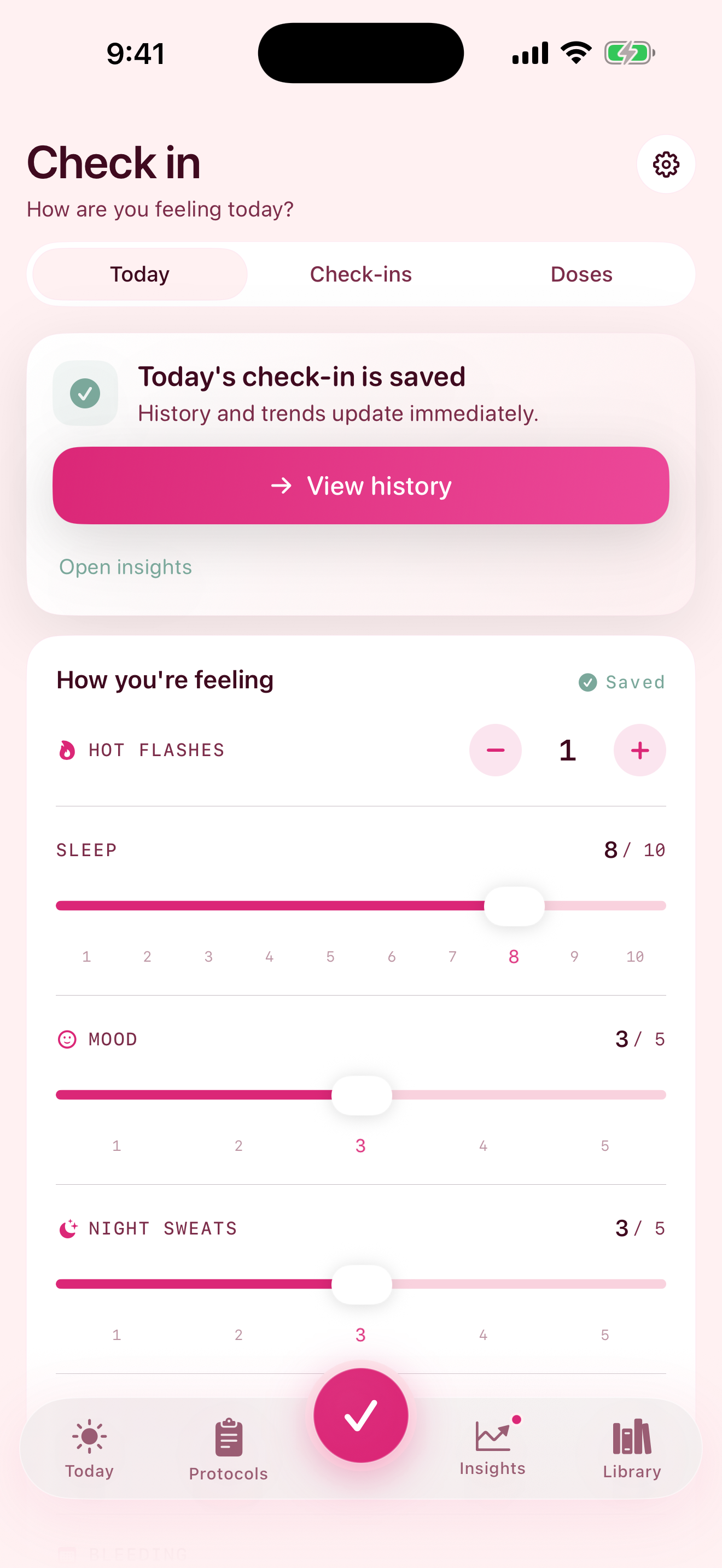
HRT AI is this template with the friction removed. The check-in is one tap per field on short scales — hot flashes and night sweats, sleep, mood, brain fog, anxiety, joint ache, breast tenderness, vaginal dryness, libido, energy, bleeding pattern — and you can add your own symptoms for anything the fixed list misses, which is the paper diary's "column no template lists".
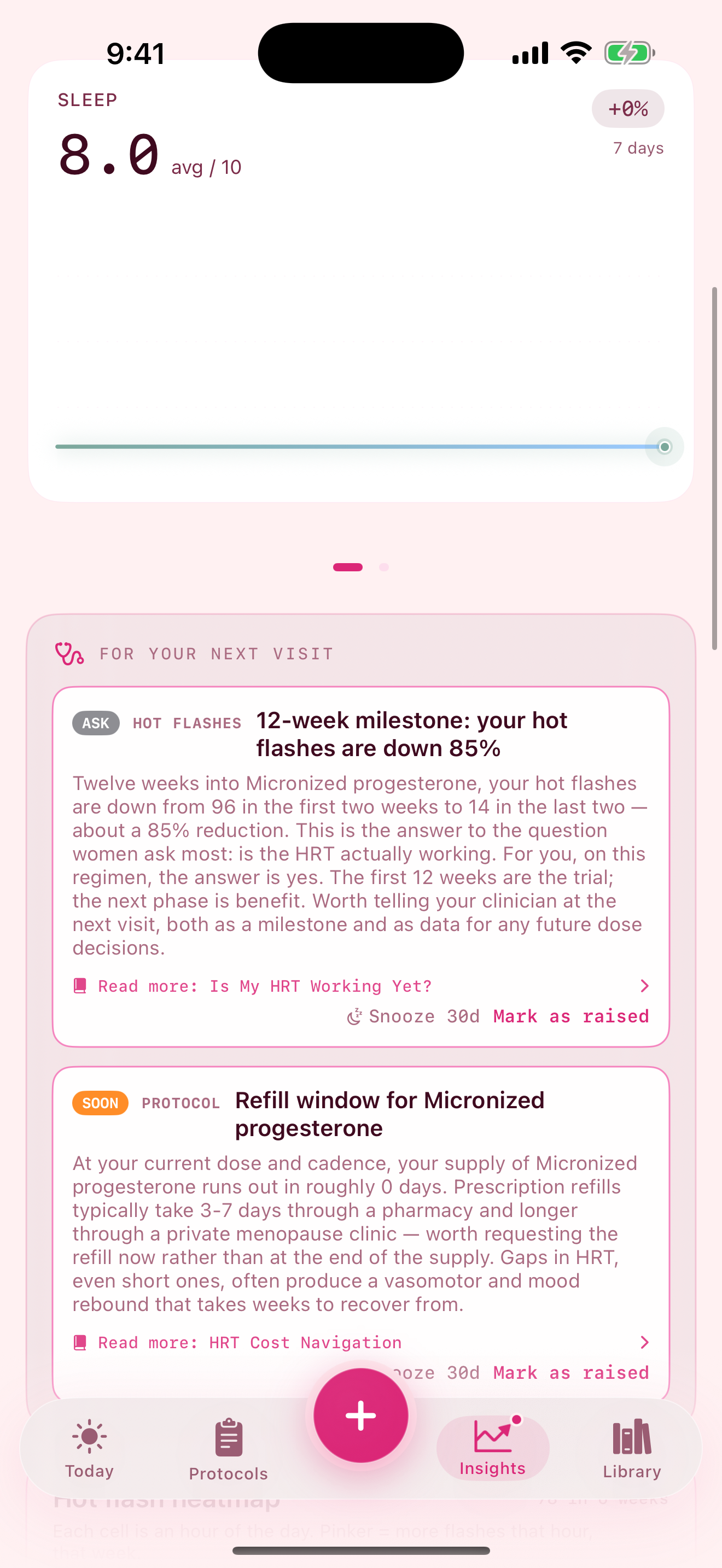
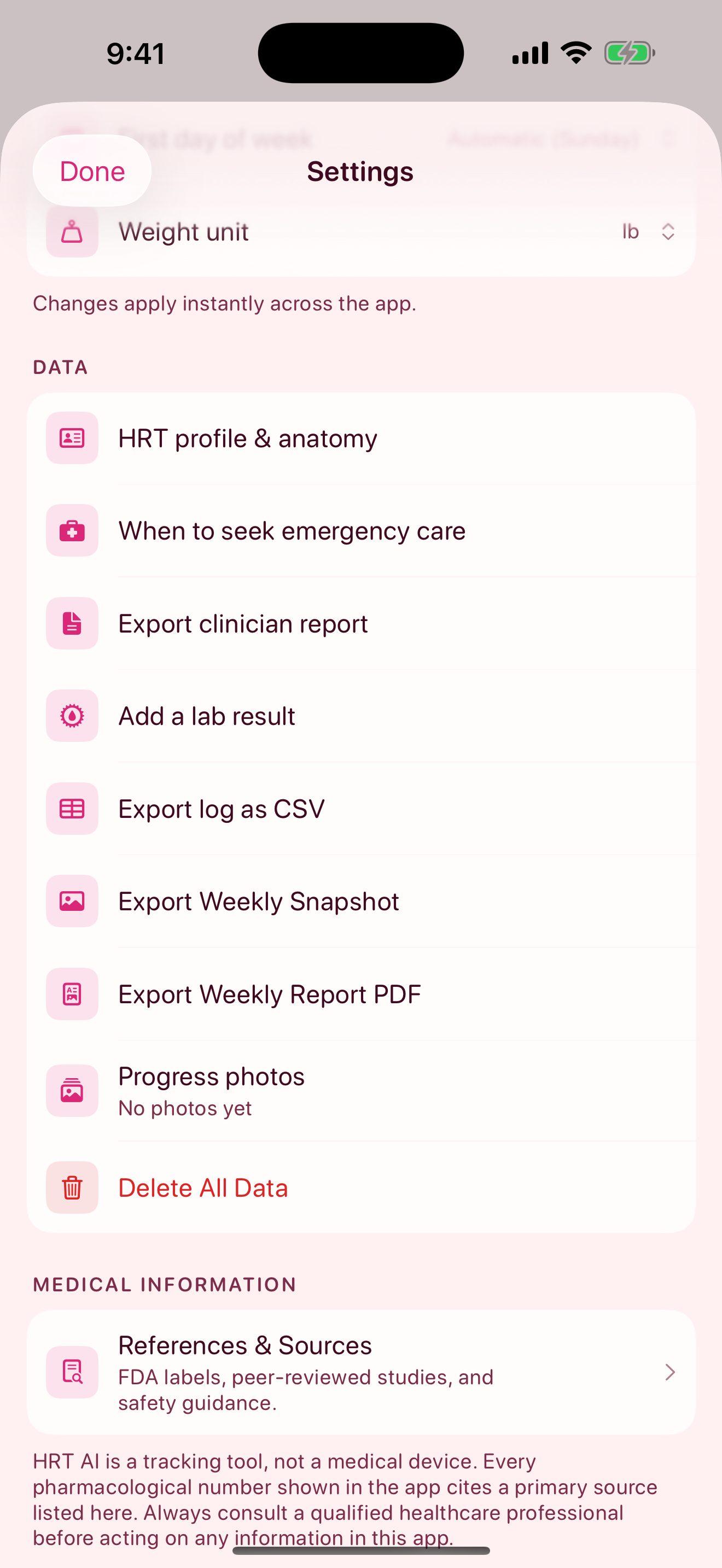
The three reading passes above happen automatically: the weekly summary names what changed and what held steady, hot-flash episodes carry timestamps so time-of-day clustering shows up as a heatmap, and the clinician report puts twelve weeks of trend, ninety days of bleeding, recent labs and your flagged questions on one page. Health data stays on the device and the summary is generated on-device. But the method is the point, and paper implements it perfectly well.