
Why route is a real variable, not a detail
Two things make route more than a matter of convenience.
The first is first-pass metabolism. Estradiol swallowed as a tablet is absorbed through the gut and passes through the liver before reaching the rest of the circulation; estradiol absorbed through skin or vaginal tissue does not take that route. This is a pharmacological difference, and it has consequences that clinical guidance addresses directly: NICE guideline NG23 notes that the risk of venous thromboembolism associated with HRT is greater with oral than with transdermal preparations. Large observational analyses of prescribing data — for example the QResearch nested case-control study published in the BMJ in 2019 — have reported the same direction of association.
The second reason is more mundane and, for tracking purposes, more important: routes fail differently. A daily tablet fails by being forgotten. A twice-weekly patch fails by falling off in the shower on day three. A gel fails by drifting an hour later each morning until the timing is meaningless. All three look identical in a log that only records a tick — and all three produce symptoms that can be misread as the therapy not working.
Transdermal: patches, gel and spray
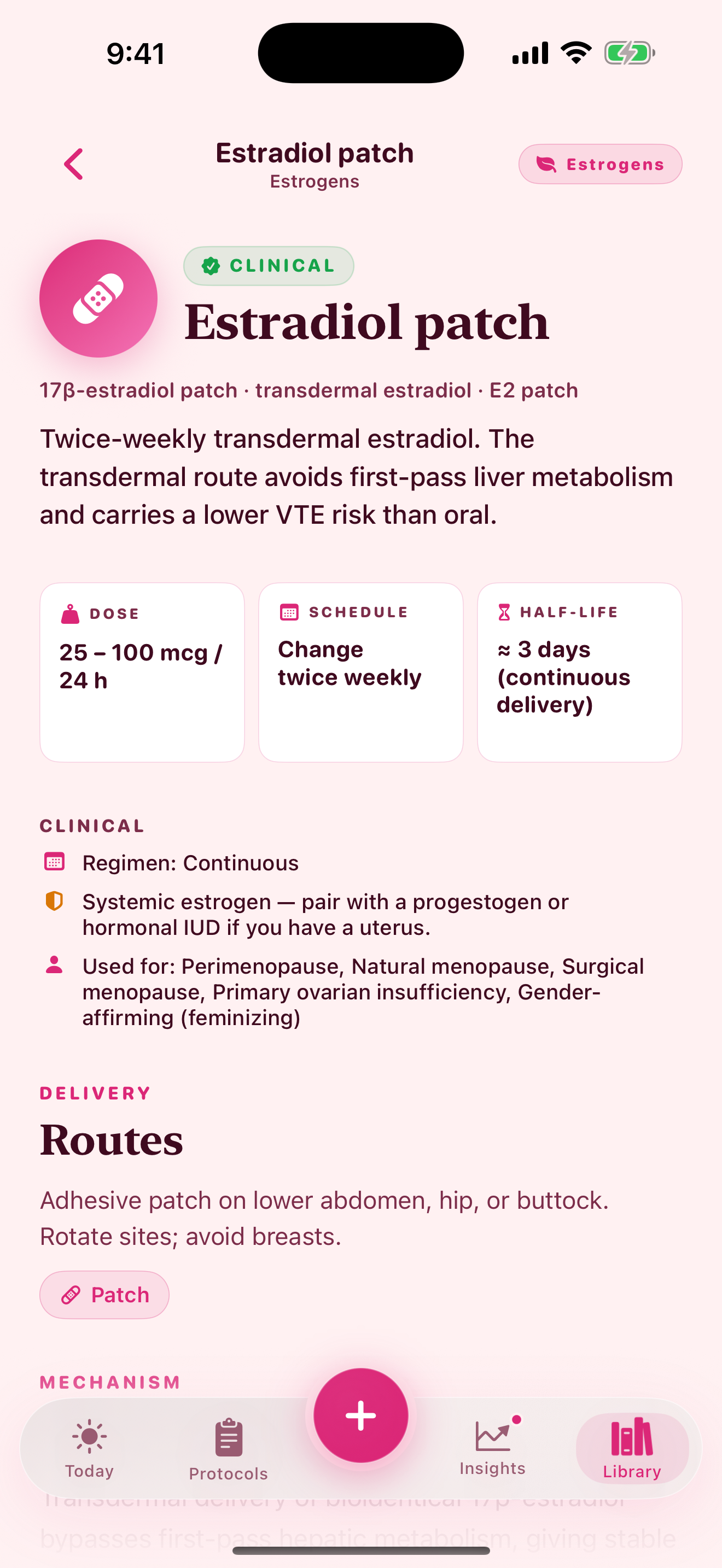
Patches
Patches are replaced on a fixed schedule — once or twice weekly depending on the product — which makes them the lowest-effort route to remember and the easiest to log. The tracking problem is not memory, it is adhesion.
What to record: the day you applied it, the site, whether it stayed on for the full interval, and if not, when it came off and what you did. Patches that repeatedly lift in hot weather, after swimming, or at a particular site are a concrete, fixable problem — but only if the pattern is written down. "The patches keep coming off" is a much weaker report than "three of the last eight came off on day two, always on the hip, always in this heat."
Also worth noting: skin reactions at the application site, and whether you rotate sites. Both come up in the conversation about whether a route is tolerable.
Gel and spray
Applied daily to the skin, so the interval is short and the compliance burden is higher than a patch. Three things characteristically go wrong, and all three are invisible in a tick-box log:
- Timing drift. Applied at 7am on workdays and noon at weekends. Not a missed dose, but a moving one — and if symptoms cluster at particular times, drift makes that pattern unreadable.
- Insufficient drying time before dressing or contact. Product information for transdermal gels and sprays specifies a drying interval and warns about transfer to other people through skin contact. Worth noting on the days it did not happen properly.
- Washing, swimming or moisturising over the site too soon after application.
What to record: the application time, not just the fact of it. For a daily transdermal route, the time is the field that carries the information.
Oral: tablets
A daily tablet is the most familiar format and the easiest to build a habit around, because most people already have a routine that involves swallowing something with water. The failure mode is straightforward forgetting, and it clusters — travel, illness, disrupted weeks, the days you leave the house early.
What to record: taken or not, and roughly when. Because oral regimens are so often taken with a fixed daily anchor, missed days tend to correlate with the anchor breaking rather than with anything about the medication. That correlation is useful to see: a run of missed doses across one specific week usually has one explanation, and it is not the drug.
Oral preparations are also where the transdermal-versus-oral distinction above is most likely to come up in your own care, which makes it worth having recorded exactly which product you are on and when it changed.
Sublingual tablets
Some estradiol tablets are used sublingually — dissolved under the tongue — rather than swallowed, which changes the absorption route and produces a much shorter, sharper profile than a swallowed tablet. It is more commonly encountered in gender-affirming care than in menopause care.
For tracking, the field that matters is time, and more precisely than for other routes: with a short profile, symptoms that cluster relative to when you took it are a genuinely meaningful observation. Also note whether a dose was accidentally swallowed rather than held, because that is a different administration entirely.
Injections
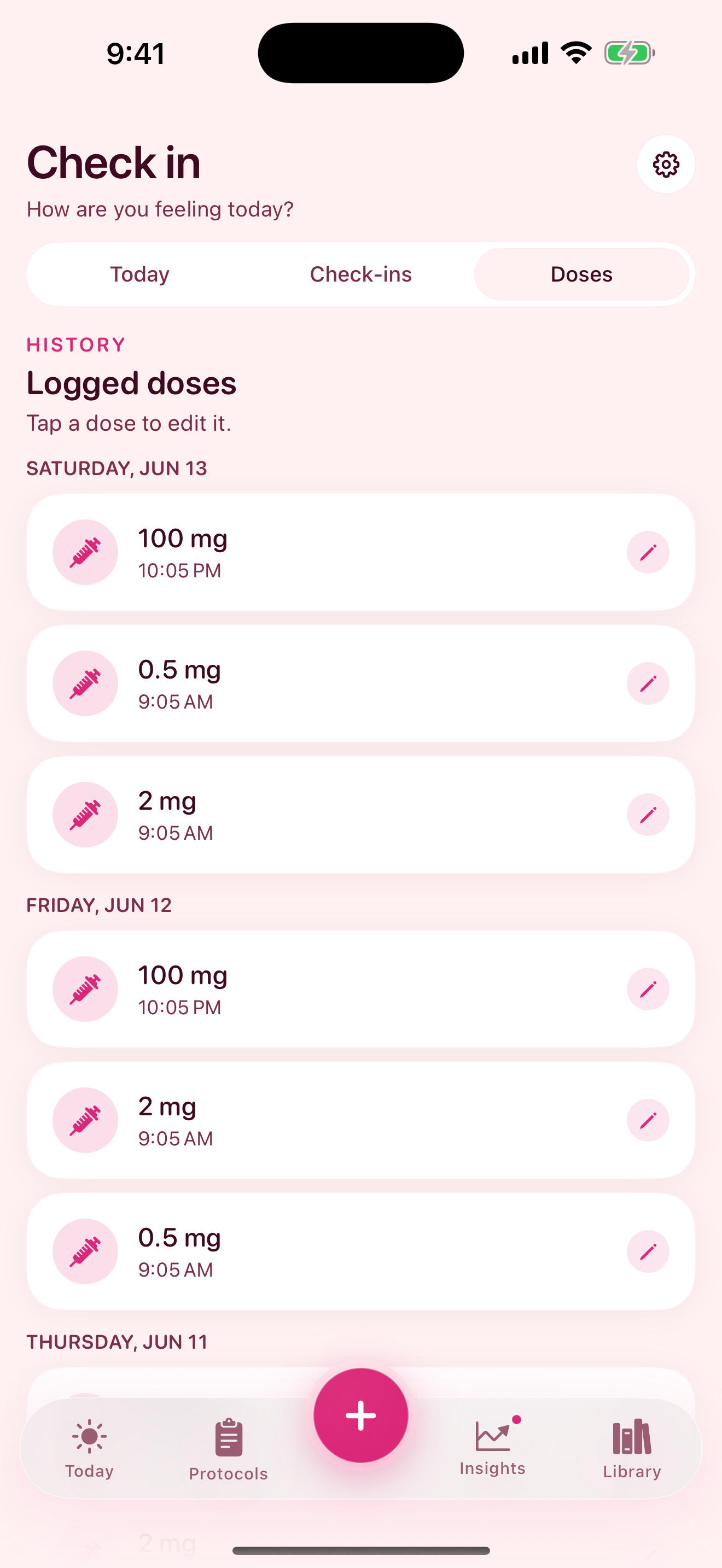
Injectable estradiol — and injectable testosterone, where prescribed — is given at intervals of days to weeks, subcutaneously or intramuscularly. Two things are worth recording that no other route needs.
The first is where. Repeated injection into the same site causes local problems, so site rotation matters, and a record of which sites have been used recently is the only practical way to rotate reliably. HRT AI holds injection sites on a body map with a per-site cooldown, so the rotation is tracked rather than remembered.
The second is where in the interval your symptoms sit. Longer intervals mean levels are not flat across the cycle, so symptoms in the last days before the next dose are a common and specific observation — but only visible if the whole interval is logged, not just the injection days. Note any local discomfort at the site as well; it is a route-specific tolerability question.
Vaginal estrogen: a separate question
Vaginal preparations — creams, pessaries, tablets and rings — are used for the local genitourinary symptoms of menopause: vaginal dryness, discomfort during sex, urinary urgency, recurrent urinary tract infections. Systemic absorption is low compared with systemic routes, and clinical guidance treats local vaginal treatment as a distinct decision from systemic hormone therapy. Some people use both, some use only one.
NICE guidance recommends offering vaginal estrogen to women with urogenital atrophy, including those on systemic HRT, and notes that treatment may need to continue because symptoms often return when it stops. That is the crucial tracking fact: unlike hot flashes, genitourinary symptoms are typically progressive rather than self-limiting, so a record of what happens during any gap in use is genuinely informative.
The characteristic adherence problem is a specific one: many regimens start with a more frequent phase and move to a less frequent maintenance phase, and once symptoms improve, the maintenance phase quietly stops happening. Symptoms then return weeks later and get reported as a new problem. Logging the maintenance applications — the ones that feel unnecessary — is what makes that story visible.
What to record: which preparation, how often it is actually used, and whether the local symptoms are improving, static or returning. Track the local symptoms separately from your systemic ones; they move on their own timeline.
Implants and pellets
Subcutaneous implants deliver hormone over a period of months from a single insertion. From a tracking perspective they invert the problem: there is nothing daily to remember, so adherence is not the variable — but the timeline becomes invisible. There is no daily action to hang a log entry on, and the interesting question shifts to whether symptoms change in a pattern as the interval progresses.
What to record: the insertion date, and then symptoms consistently across the whole interval. If symptoms return towards the end of an interval, that shape is only visible if the middle weeks were recorded too — which is exactly when people stop, because nothing is happening.
One point of caution worth knowing: compounded hormone pellets, prepared individually rather than as licensed products, are a different thing from licensed implants. Professional bodies including ACOG and The Menopause Society have advised caution about compounded bioidentical hormone preparations, on the grounds that they are not subject to the same regulatory review of purity, dose consistency and labelling as approved products. If you are using a compounded preparation, recording the exact product and provider matters more than usual, because the details are less standardised.
The progestogen component, and why it is tracked separately
For anyone with a uterus taking systemic estrogen, a progestogen is used for endometrial protection. It may be micronized progesterone, a synthetic progestogen, or delivered by an intrauterine system, and it may run continuously or sequentially — taken on certain days of a cycle.
Sequential regimens are the single biggest source of logging error in hormone therapy, and the reason is structural: the correct action depends on where you are in a cycle, so "did I take my HRT today?" has no fixed answer. Log estrogen and progestogen as separate components with their own schedules. A combined single entry cannot represent a regimen where one component runs daily and the other runs on days 15 to 26.
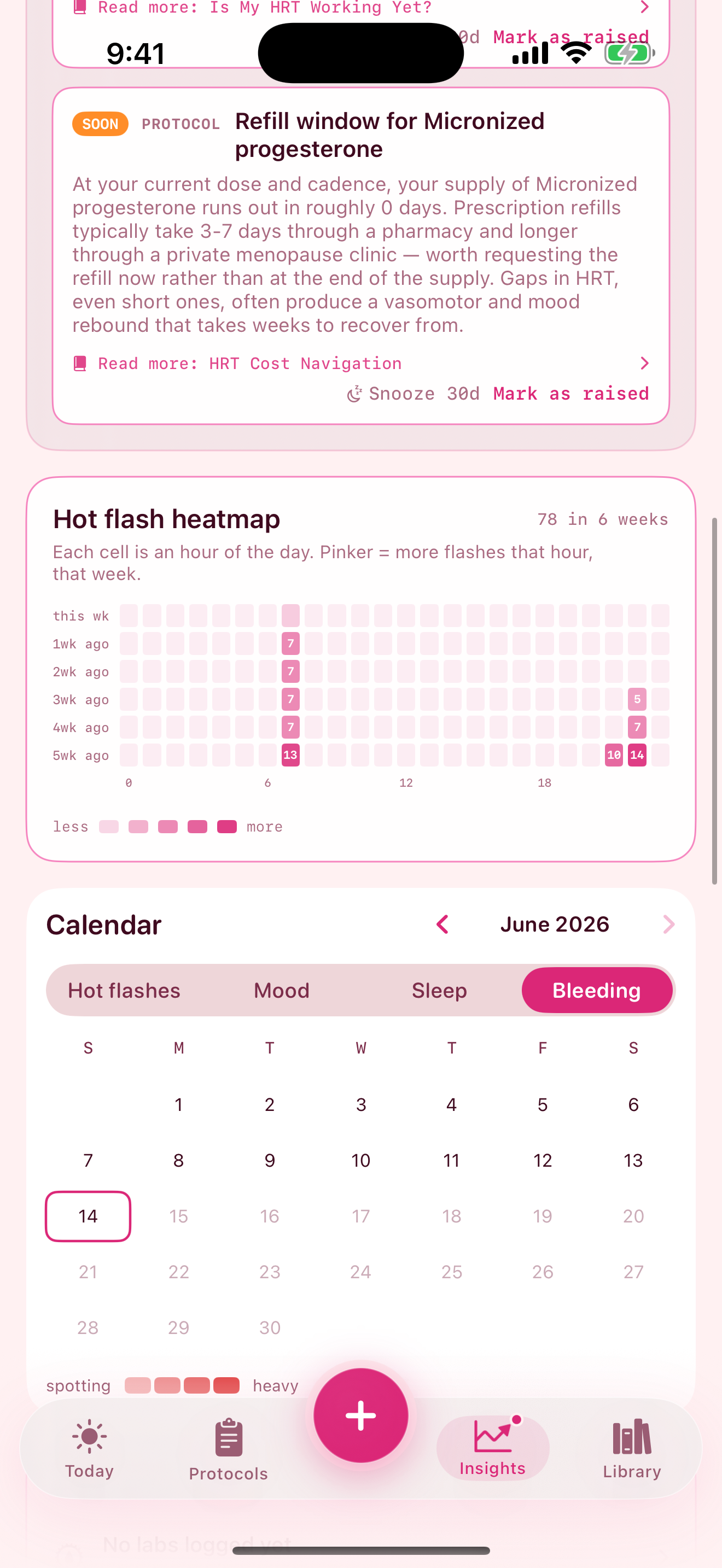
Also record any bleeding, and its timing relative to the progestogen phase. Expected withdrawal bleeding on a sequential regimen and unexpected bleeding are different findings, and the difference is entirely a matter of dates. Unexpected or persistent bleeding on hormone therapy is something to raise with a clinician rather than monitor indefinitely.
This is what "phase-aware" means in HRT AI: the protocol holds each component with its own schedule, and the reminder knows which compound belongs to which day, including mid-cycle. Testosterone or DHEA, where prescribed, are logged as further separate components for the same reason.
The routes side by side, from a logging point of view
| Route | Interval | Characteristic failure | Field that catches it |
|---|---|---|---|
| Patch | Once or twice weekly | Falls off or lifts early; site reactions | Application date, site, whether it lasted |
| Gel / spray | Daily | Timing drift; too little drying time; washed off | Application time, not just yes/no |
| Oral tablet | Daily | Forgotten, usually in clusters | Taken/missed with the date |
| Sublingual | Daily or more often | Swallowed instead of held; short profile makes timing matter | Exact time; whether it was held or swallowed |
| Injection | Days to weeks | Site overuse; symptoms drifting late in the interval | Site used, plus symptoms across the whole interval |
| Vaginal | Varies; often a maintenance phase | Maintenance phase quietly stops once symptoms ease | Each use, plus local symptoms tracked separately |
| Implant / pellet | Months | Nothing to forget — but the interval becomes invisible | Insertion date, plus symptoms across the whole interval |
| Progestogen (sequential) | Specific cycle days | Wrong day, or logged as one thing with the estrogen | A separate component with its own schedule; bleeding dates |
The boring one: running out
Interruptions in hormone therapy are frequently supply problems rather than clinical decisions — a prescription not renewed in time, a product out of stock, a repeat request that fell through while you were away. From the outside, a supply gap is indistinguishable from non-adherence, and both look like the therapy failing.
So count what you have left, and note the reason for any gap. "Nine days without estradiol because the pharmacy had none" is a completely different entry from "nine days missed", and it changes what should happen next. HRT AI tracks inventory by container — patch boxes, blister packs, gel pumps, sprays, sachets, rings, tubes, vials, ampoules and pre-filled syringes — flags low stock as a share of the pack rather than a fixed number, and estimates doses and days remaining so the refill prompt arrives before the gap rather than during it. It also records a reason when a protocol is paused, so a supply interruption is distinguishable in the record from a clinical decision or a side effect.
For what to do when something new starts after a route change, see side effects and changes worth writing down. For how to compress all of this into an appointment, see what to bring to a menopause appointment.