Why preparation changes the outcome
For most people over 45, menopause is diagnosed from symptoms rather than a blood test — NICE guideline NG23 is explicit that perimenopause and menopause should be identified in women aged over 45 without laboratory tests. Your account of your symptoms is the evidence. If that account is vague, the assessment it supports is vague.
The same guidance frames the treatment conversation as shared decision-making: the clinician sets out benefits and risks in the context of your history, and you decide together. Shared decisions need two informed parties. Turning up with dates, numbers, and two clear priorities is what makes you the second one.
1. A dated symptom summary, in numbers
The most common failure is answering "how are the symptoms?" with "not great". It is honest and it is unusable. Replace adjectives with counts wherever you can:
- Hot flashes and night sweats: average episodes per day over the last two weeks, counted separately, with roughly what share were moderate or severe. See how to track hot flashes for the method.
- Sleep: how many nights a week you wake, and whether you wake drenched or for no clear reason — a distinction covered in sleep and mood tracking.
- Mood and cognition: how many days a week are affected, and whether it tracks anything else (cycle timing, sleep, dose timing).
- Bleeding pattern: cycle length, how variable, and any bleeding that is new, unexpected, or unusually heavy.
- Genitourinary and sexual symptoms: vaginal dryness, discomfort during sex, urinary urgency or recurrent urinary infections. These are chronically under-reported because they are awkward to raise, and they respond to specific treatments — which is exactly why writing them down beforehand helps.
- Anything new since the last visit, with its start date.
Include the comparison. The same figures from a month or three months ago turn a snapshot into a direction, and direction is usually what determines whether anything changes. Improving, static, and worsening lead to three different conversations.
2. Your regimen as you actually take it
Not what is on the prescription — what actually happens. These are different for most people, and the gap between them is diagnostic information rather than a confession:
- Every hormone preparation you are using, by name and form (patch, gel, spray, tablet, vaginal preparation, implant, injection).
- How often you take or apply each one, and roughly what time.
- How many doses you missed in the last month, and why. A patch that will not stay on, a gel you forget on work mornings, and a tablet you deliberately skip because of a side effect are three different problems with three different solutions.
- When the current regimen started, and what changed at that point.
- What you were on before, and why it changed. This is the detail most often lost between appointments and clinicians.
Different routes fail in different, predictable ways — see estradiol delivery routes and what changes about tracking each. Naming the failure mode out loud is often more productive than reporting the symptom it caused.
3. Medications, supplements, and the history that affects risk
Risk assessment for hormone therapy is individual, and it depends on facts a clinician cannot guess. Have these to hand:
Everything else you take
Prescription medicines, over-the-counter medicines, herbal products and supplements. Some interact with hormone therapy or with each other; several herbal products marketed for menopause have documented interactions. "Nothing, just a few supplements" is the answer that causes problems.
Your own medical history
Blood clots, stroke, heart disease, migraine (and whether with aura), high blood pressure, liver disease, diabetes, breast or gynaecological cancer, gallbladder disease, and whether you still have a uterus and ovaries. Surgical history matters: an oophorectomy changes the picture entirely.
Family history
Breast, ovarian and endometrial cancer, and venous thromboembolism, in first-degree relatives, with ages at diagnosis where you know them. Ages matter as much as the diagnosis.
Screening status
When you last had cervical screening, a mammogram where applicable, a blood pressure reading, and any bone-density scan. Being able to say "last month" or "four years ago" saves a chunk of the appointment.
4. Your two priorities, written down
This is the part people skip and the part that most changes the appointment. Symptom lists are long. Ten minutes is short. If you do not choose, the agenda is set by chance — usually the first thing you mention, which is often not the thing wrecking your life.
So decide beforehand, and be concrete about the outcome you want. Not "the sleep" but "I want to stop waking at 3am four nights a week." Not "I feel awful" but "the brain fog is affecting my work and I want to know whether that is likely to be part of this." A specific target gives the clinician something to aim at, and gives you a way to tell at the next visit whether anything worked.
Write both at the top of your notes. Say them in the first minute.
5. Questions worth asking
Adapt these to your situation. The point is to leave with a plan you understand rather than a prescription you do not.
- Based on my history, what are the specific benefits and risks for me — not the population average?
- What are the options here, including the non-hormonal ones? NICE guidance covers non-hormonal approaches including cognitive behavioural therapy for vasomotor symptoms and for low mood arising in this context.
- How long before we would expect to know whether this is working, and what will we measure?
- What would make you change or stop this?
- Which side effects are expected and settle, and which mean I should contact you?
- Do I need a progestogen for endometrial protection, and why or why not in my case?
- Are my genitourinary symptoms being treated separately? Local vaginal treatment is a distinct question from systemic therapy.
- When is the review, and what should I bring to it?
- If this does not work, what is the next option?
Write the answers down during the appointment, or immediately after. Post-appointment recall is poor, and a plan you cannot reconstruct is not a plan.
If you feel dismissed
It happens, and it is not evenly distributed — people with early menopause, premature ovarian insufficiency, surgical menopause, and those on gender-affirming hormone therapy all report having to argue harder to be assessed properly. A few things that help without turning the appointment adversarial:
- Lead with the record. A dated log with numbers is much harder to wave away than a description, precisely because it is evidence rather than impression.
- Name the functional impact. "I have missed four days of work in six weeks" lands differently from "I feel terrible", because it is specific and checkable.
- Ask for the reasoning to be recorded. "Could we note in my record that we discussed HRT and the reason for the decision?" is a reasonable request and creates continuity for the next visit.
- Ask what would change the answer. It converts a refusal into a criterion you can work towards.
- Ask about a referral to a clinician with a specialist interest in menopause, or seek a second opinion. Menopause-specialist directories are published by several national societies.
The shortcut
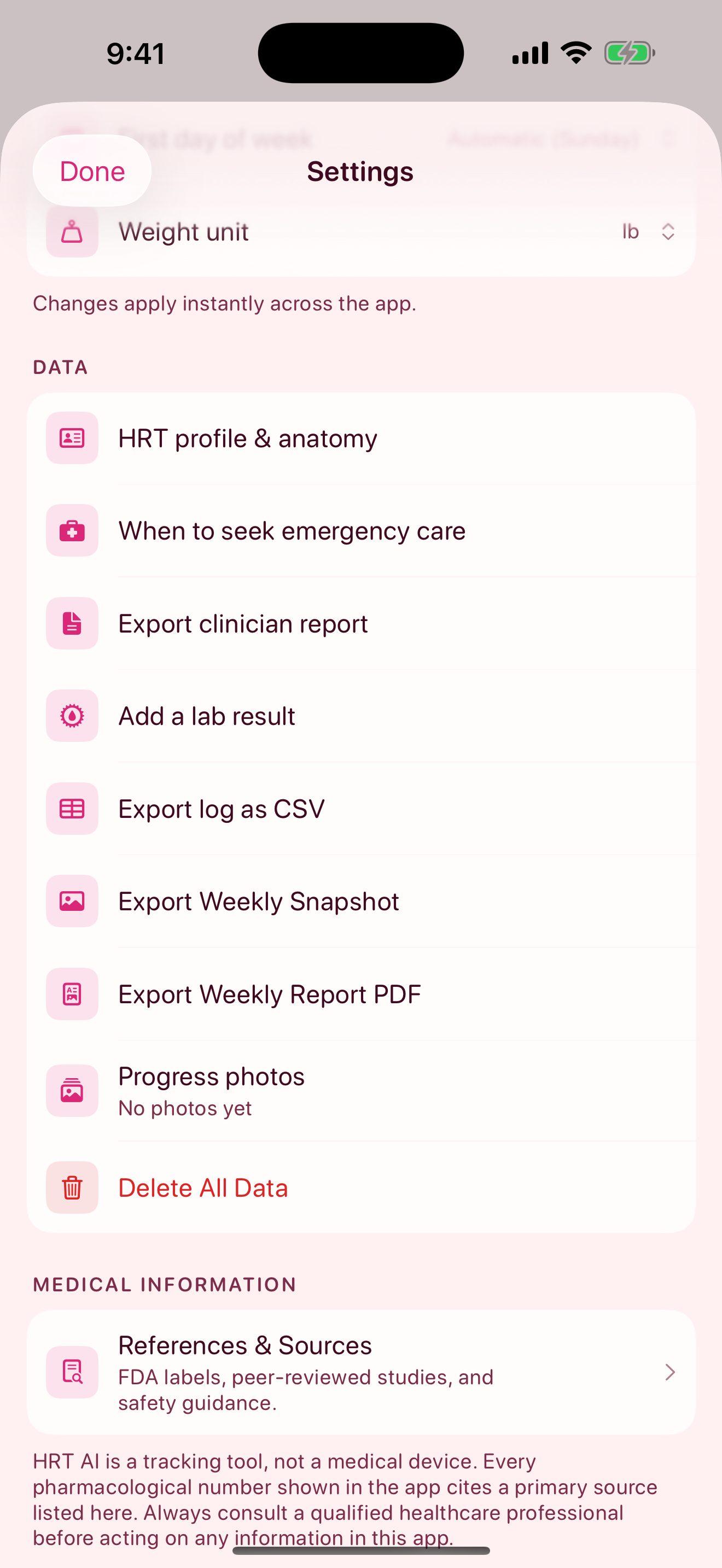
All of the above is one page of paper. If you keep a running log, most of it is already written and the preparation is just reading it back. That is what the HRT AI clinician report is for — one tap produces a single-page PDF containing:
- your current regimen, with how many weeks you have been on it;
- dose and route changes over the last six months;
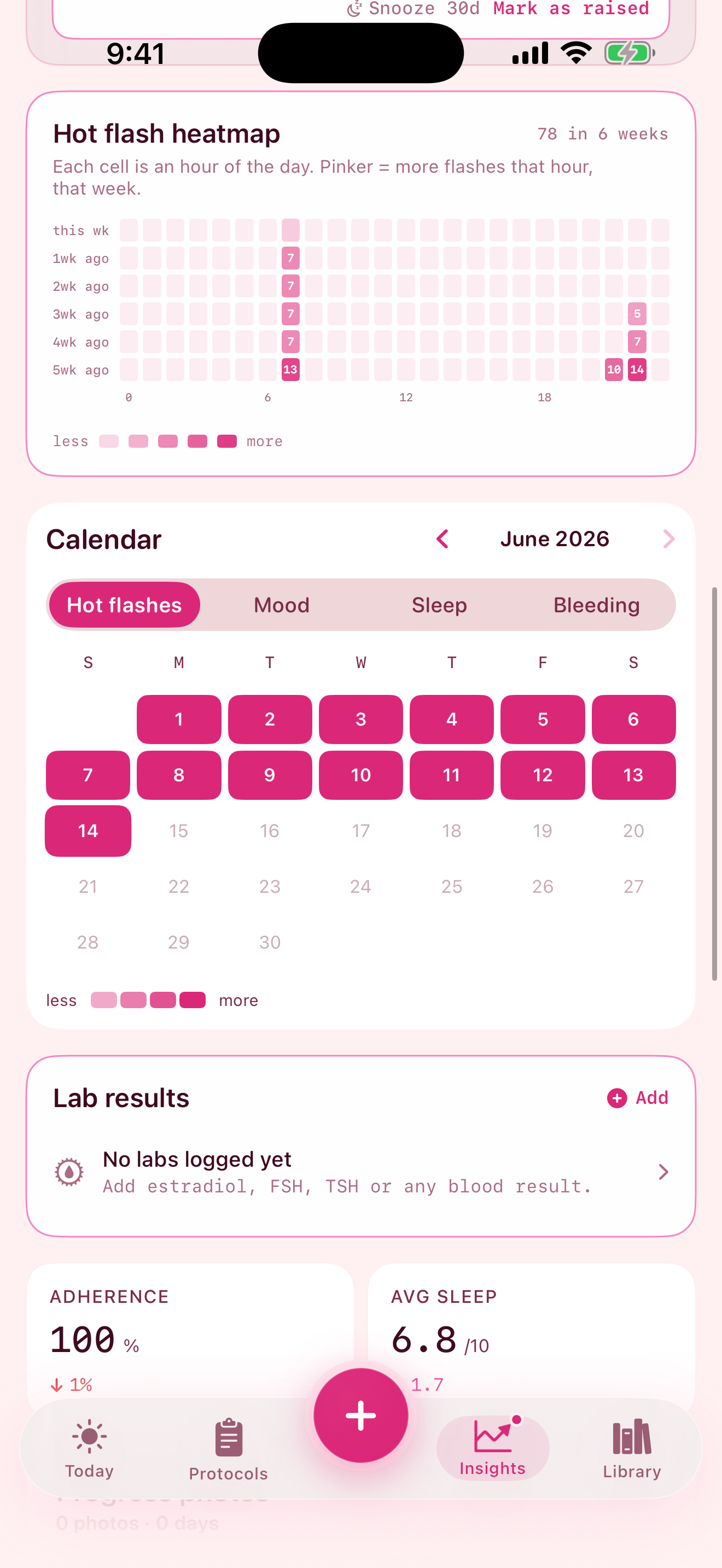
- the hot-flash trend and symptom averages for the last twelve weeks;
- any custom symptoms you added, on the same twelve-week window;
- a ninety-day bleeding calendar (omitted entirely if you have no uterus);
- recent lab results with whether each sat inside the typical range, in your own units;
- and the questions you flagged for this visit, each carrying its source.
So the numbers are worked out before you sit down. The weekly summary also ends with something worth raising next time, which tends to be where the two priorities come from — and where a symptom pattern crosses a threshold worth mentioning, the app files it as a question for the appointment rather than telling you what it means.