Why night sweats and insomnia must be separate fields
Sleep disruption is among the most commonly reported problems in the menopause transition, and it has at least two distinct mechanisms that look identical at 3am.
One is vasomotor: a night sweat wakes you, you are hot and damp, you cool down, you go back to sleep or you do not. The other is a primary sleep disturbance — waking without a flush, or lying awake unable to get back to sleep, or difficulty falling asleep in the first place. Both are real and both are common in this population. They are not the same finding, and the management conversations they lead to are not the same either.
A log that records only "slept badly" cannot distinguish them, so the distinction gets made in the appointment from memory — which is exactly the kind of question memory answers badly. Two fields instead of one solves it at essentially no cost.
The three sleep fields
1. Number of wakings
A count, recorded in the morning. Not sleep duration — duration is the field people try to record and then guess, because nobody knows when they fell asleep. Wakings are memorable in a way total sleep time is not, and for menopausal sleep disruption they are the more informative number anyway: fragmentation is usually the problem, not a short night.
If you use a wearable, its numbers are a useful supplement but not a substitute. Consumer sleep-tracking estimates sleep stages from movement and heart rate and does not distinguish "woke up drenched" from "woke up for no reason" — which is the distinction that matters here.
2. Why you woke — sweating or not
The single most valuable field on the page, and the one almost every diary omits. A binary is enough: was there a night sweat, yes or no. If some wakings were and some were not, record both counts.
This field is what makes the rest interpretable. Someone waking four times a night, all four with sweats, and someone waking four times with none, have written the same "4" in the previous field and are describing different problems.
3. How the next day went
Daytime function is the part clinicians act on, and it is not reliably predicted by the night. Some people function on broken sleep; some are wrecked by one interrupted night. A simple three-point scale — fine / tired but functioning / not functioning — recorded consistently is enough.
This field also carries the impact statement you will need in an appointment. "I have not slept through a night in four months and I have made mistakes at work in three of the last four weeks" is a sentence built out of daily entries, and it is far more actionable than "I am exhausted."
Mood: one scale, held steady, plus impact
Mood tracking fails in a specific way: the scale drifts. A 4 in January is not the same 4 in June, because your reference point has moved. There is no complete fix, but two things help a great deal.
First, anchor the ends in writing when you start. Not "1 to 5" but "1 = as low as I have been this year, 5 = as good as I get." Re-read the anchors occasionally. Second, record impact separately from feeling: did it change what you did today — cancelled something, snapped at someone, could not start a task? Impact is much less prone to drift than a subjective rating, and it is what a clinician can act on.
Worth logging alongside mood, because both are commonly reported and both are frequently attributed to something else:
- Irritability separately from low mood. People often report these moving independently, and lumping them loses that.
- Anxiety separately again — including the specific pattern of waking anxious, which is common and which links the sleep and mood records together.
- Brain fog: word-finding difficulty, losing the thread mid-sentence, forgetting why you walked into a room. Record whether it affected work or driving. Cognitive complaints during the transition are frequently reported and frequently dismissed, and a dated record is the difference between "I feel like I am losing it" and evidence.
The two links worth looking for
Once you have three or four weeks of entries, two comparisons do most of the work.
Mood against last night's sleep
Line up today's mood with the previous night's wakings. If bad days follow bad nights almost every time, sleep is the lever worth discussing first. If mood is low on well-slept days too, something else is contributing — which is important information, not a failure of the exercise.
Symptoms against cycle timing
If you are still cycling, mark cycle day. Symptoms clustering in a consistent phase is a pattern; symptoms scattered across the cycle is a different pattern. On a sequential hormone regimen, the timing of the progestogen phase matters too — some people report mood changes that track it, and the only way to know whether yours do is dates.
You do not need statistics for this. Three weeks of two columns side by side is usually enough to see whether a relationship exists. What you should not do is decide what it means: an apparent link is a hypothesis to put in front of someone who can test it against everything else about you.
What a sleep and mood diary cannot settle
This is the part to be blunt about, because it is where symptom tracking gets dangerous if oversold.
A diary cannot tell you whether you have depression or an anxiety disorder requiring treatment in its own right. Those are clinical diagnoses, they can co-occur with the menopause transition or be entirely separate from it, and attributing everything to hormones is a well-documented route to leaving a treatable condition untreated. It cannot rule out obstructive sleep apnoea — which becomes more common with age, is under-diagnosed in women, and presents with exactly the broken sleep and daytime exhaustion described above. It cannot rule out thyroid disease, anaemia, or medication effects, all of which produce overlapping symptoms.
NICE guidance recognises cognitive behavioural therapy as an option for low mood or anxiety arising as a result of menopause, and professional bodies have published position statements on nonhormone approaches including CBT for insomnia. Which, if any, applies to you is a clinical judgement. The record's job is to make that judgement better informed, not to pre-empt it.
If you are having thoughts of harming yourself, do not wait for an appointment or a pattern to emerge. Contact your clinician, an urgent care service, or a crisis line in your country now.
Keeping it up on the bad days
The cruel structure of mood tracking is that the days most worth recording are the days you least want to record anything. Any diary requiring effort will therefore have gaps precisely where the useful data was.
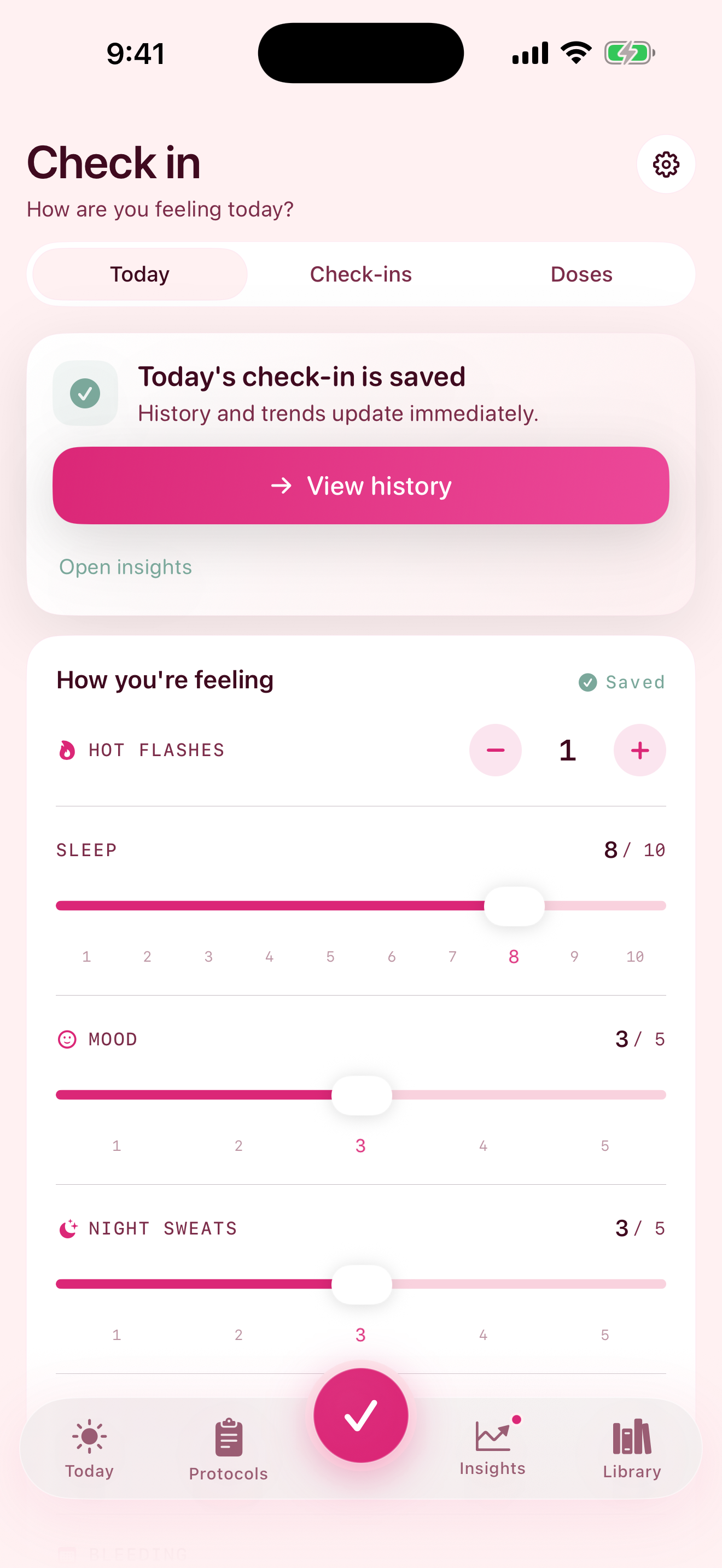
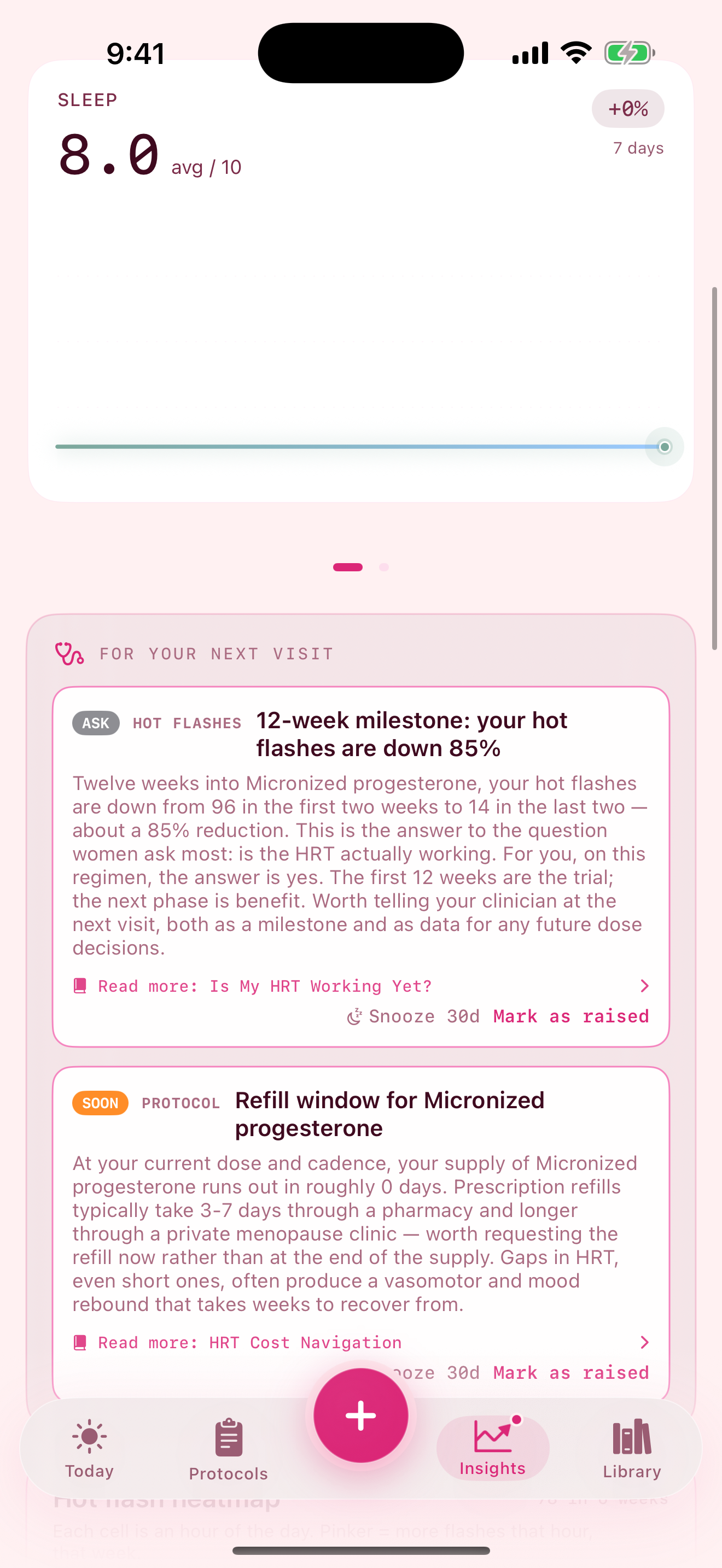
So make the bad-day entry trivially small. One tap per field, no free text required. In HRT AI, sleep and energy sit on a 1-to-10 slider; mood, brain fog, anxiety and the rest are short 1-to-5 taps; night sweats are separate from daytime flashes by default, because anything logged between 22:00 and 06:00 is classified as a night sweat automatically. The card closes when you save — small enough that a bad day still gets recorded, which is the whole point. The weekly summary then names what changed and what held steady, and the clinician report puts twelve weeks of mood, sleep and energy averages on one page alongside everything else. See the symptom diary template for the same structure on paper.